Housing Plus! A home for a fresh start, an opportunity to build inclusion
Susanna Fiorletta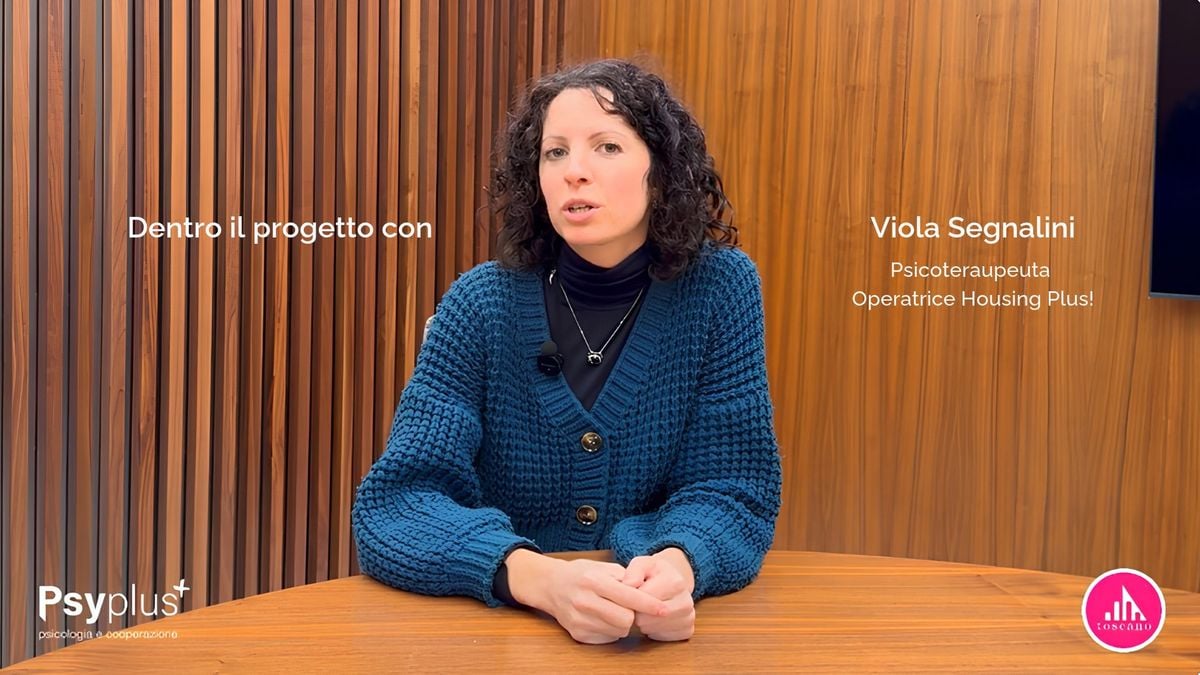
The Housing Plus! project by PsyPlus continues to grow. We first discussed it with Giulio Ciucci, the project manager, who told us about how the initiative began and the decision to bring the Housing First model to Rome: an approach that considers housing the starting point for a journey toward independence and inclusion.
Since then, the project has moved forward, expanding its network of collaboration with local institutions, funders and citizens, and welcoming new people. It is a journey that requires more than just providing housing: it also involves ongoing support, from managing everyday life to accessing services, as well as psychological and social support and reintegration into the community.
This time, we have chosen to tell the story of Housing Plus! from the perspective of someone who supports beneficiaries in their daily journey: Viola Segnalini, a psychotherapist in training and a project support worker.
Viola, first of all, tell us about your role in the Housing Plus! project.
As a support worker for the Housing Plus! project, I accompany beneficiaries through their journey of living in a home through a series of activities.
First of all, I would like to clarify something: one of the principles of Housing First is that people have the right to choice and control. There is no coercive approach, so everything we do is discussed and developed together with the beneficiary.
We give beneficiaries a “gentle nudge,” and when resistance arises, we try to discuss it together, establish a dialogue and facilitate the process of settling into their new home.
Housing Plus! is the project that brought the Housing First model to Rome. What does it involve, and how does it differ from the traditional support system for people experiencing homelessness?
Housing Plus! is dedicated to adults experiencing severe social exclusion and reverses the traditional support system.
In Italy, a more assistance-based model has historically prevailed, also known as the “staircase model,” in which housing represents the final destination.
Housing First reverses this model: it starts with a home, which becomes the starting point of an open-ended journey aimed at helping the beneficiary achieve a state of well-being.
This well-being is personalized, meaning that the person decides for themselves what they want to achieve and how to achieve it.
What does it mean to move into a home after spending many years on the streets? What aspects do you work on during the first stage of the journey?
The activities I carry out with beneficiaries are varied.
The first focuses specifically on readjusting to living in a home through a series of everyday activities: cleaning the house, cooking, following a healthy diet and personalizing the spaces, whether their own room or the other areas of the home.
In practice, we help beneficiaries readjust to living in a home by taking care of it every day, also raising awareness about electricity and water consumption and waste sorting.
During the initial stage, we work together to understand which accessories and household items are needed and what needs to be purchased for home maintenance and cleaning.
Several beneficiaries have spent many years on the streets, sometimes more than thirty years, so certain habits have been lost and need to be relearned. The goal is to make the home a safe space for the person and allow them to regain a sense of security and well-being within it.
People experiencing homelessness do not feel comfortable living on the streets, which they experience as a place full of dangers, especially at night.
Let me give you an example: the first beneficiary I supported slept for a very long time during his first night in the house. When I asked him why he had woken up at noon, he replied that he had not experienced such restful sleep in a very long time.
We have seen how housing is the starting point of the beneficiaries' journey.
Exactly. After the initial adjustment period in the home, during the second stage we help them connect with medical and social services: their general practitioner, the Mental Health Center (CSM) or Addiction Services (SerD) when necessary, social services, the Tax Assistance Center (CAF) and the employment center.
All of this, as I mentioned earlier, is discussed and agreed upon with the person. Support in accessing services may involve, for example, obtaining the Inclusion Allowance (Assegno di Inclusione) or starting socially useful activities, such as volunteering with a small expense reimbursement, through which people reconnect with society.
For example, one of our beneficiaries volunteers for a service dedicated to mothers and newborns, where he handles warehouse operations and the storage of clothing, food and other supplies; another has chosen to dedicate himself to the environment and street cleaning.
Alongside housing, there is also important psychological support.
Exactly. Another fundamental activity is psychosocial support, which is developed through the relationship with the support worker.
Our goal is to ensure that, through this relationship, the person can reintegrate aspects of themselves that they have separated from their sense of self over time.
For example, a beneficiary I support always tells me that certain aspects of his life are locked away in a drawer. So one of the things we are doing is trying to open those drawers. One of his wishes since he was young was to play the electric bass, so with our help, he bought an electric bass and started playing it.
As support workers, we have a transitional role, meaning that we accompany beneficiaries between two states of being, reconnecting what belongs to the person's past with their present and future. Moving into a home is a complex, difficult transition, full of fears and ambivalence.
What is the ultimate goal of the journey with you?
The ultimate goal is not predetermined. Instead, the person, together with the support worker, decides what they want to achieve. This is because the journeys are not standardized but personalized.
We can think of an ideal goal as the person's ability to project their desires onto their home. If the home is the physical representation of one's psychological space, taking care of the home becomes a reflection of the person's emotional well-being.
Many of the beneficiaries live together in the same home. What role does shared living play?
Most of the beneficiaries welcomed into our project live in shared housing, while only a few live in studio apartments.
In our experience, shared living has proven to be a good way to work on relationships and reintegration into society. It gives people the opportunity to recognize and become aware of others while also recognizing and accepting certain aspects of themselves, even uncomfortable ones, reflected in others.
Shared living therefore makes it possible to work on these aspects and represents a first step toward reintegration into society.
How do you support beneficiaries in managing communal living?
There is a dedicated space called “facilitation,” in which a psychologist holds a meeting with all the roommates twice a month.
It is a time to discuss the positive and negative aspects of living together, any conflicts that may have arisen, and everyone's needs and requirements.
The facilitator also acts as a mediator: they establish a productive dialogue among the roommates, helping them discuss what has not worked well in the home and express their wishes and what they would like.
For example, in one apartment, the roommates decided to allocate part of the money from their shared fund to purchasing something for the home. They chose a tool for making fresh egg pasta because one of the beneficiaries, who comes from the Romagna region, cared deeply about having one.
What role does the trauma associated with losing one's home and personal relationships play in the lives of the people you support?
Losing a home is always a form of trauma. This is why we have a dedicated psychological support service provided by our psychotherapists, aimed at helping people reclaim their own identity.
This service is offered specifically to reconnect the experiences associated with having a home with everything that has been lost, including one's network of personal relationships.
Through this service, we stand alongside people so they can revisit their painful personal histories.
Compared with when the project began, where are you today?
We are growing and are able to welcome more and more people. This is why we need more homes.
The project has solid funding: as an association, we sign the apartment rental agreements in our own name. These are residential, non-temporary leases because one of the Housing First slogans is precisely “for as long as necessary.”
Our Housing Office is responsible for communicating with landlords and condominium residents and also manages everything related to routine maintenance and taking care of the home.
The availability of housing is essential to expanding the project. What would you like to say to homeowners today?
What I would like to convey to homeowners is to have trust.
Trust in the idea that society's well-being is built through welcoming others. A willingness to welcome that does not come only from opening up physical spaces, but also from the ability to embrace what is different from ourselves.
And I would like to offer a provocative thought that concerns everyone, including myself: there is a common thread connecting us to people experiencing homelessness. We share certain life experiences. What saved us, however, was having a support network around us.